
Meta Reality Labs Posts $4.97 Billion Quarterly Loss as XR Spending Continues
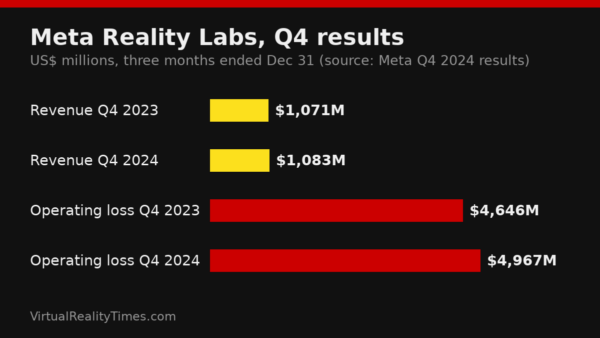
Meta’s long-term investment in virtual and augmented reality remains exceptionally expensive. In financial results released January 29, the company reported a $4.967 billion operating loss for Reality Labs during the fourth quarter of 2024, compared with $1.083 billion in revenue for the same division.
The annual numbers are even more striking. Reality Labs lost $17.729 billion from operations across 2024 on revenue of $2.146 billion. The division encompasses Meta’s VR, AR and mixed reality hardware, software and related services, making the results an important but imperfect financial window into the Quest ecosystem and the company’s ambitions for smart glasses.
The contrast with Meta’s advertising business could hardly be greater. The company’s Family of Apps segment remains highly profitable, giving Meta the resources to continue funding hardware development even as XR products operate at a substantial loss.
Sales grow into the holiday quarter, but losses dominate
Reality Labs’ fourth-quarter revenue was slightly higher than the $1.071 billion recorded a year earlier. It also represented roughly half of the division’s revenue for all of 2024, reflecting the importance of the year-end shopping season for consumer devices.
At the same time, the operating loss increased from $4.646 billion in the fourth quarter of 2023 to $4.967 billion in the latest period. Across the entire year, the loss rose from $16.120 billion to $17.729 billion.
These figures are operating results, not a direct count of cash spent solely on VR headsets. They include broader costs associated with research, product development and the businesses grouped inside Reality Labs. It is therefore inaccurate to divide the loss by the number of Quest headsets and describe the result as a loss per device.
Meta does not break out the division’s total revenue into a simple public tally for Quest hardware versus smart glasses, app sales and other activities in this release. Readers should be cautious about claims that one product category accounts for a particular share without additional evidence.
Quest is only one part of the investment
Meta’s XR operation has gradually become broader than the conventional image of a metaverse represented by people wearing VR headsets. Quest remains central to immersive games and mixed reality applications, while Ray-Ban Meta glasses demonstrate a different path into wearables: lighter devices built around cameras, audio and AI assistance rather than full virtual environments.
Those categories have different economics. A high-performance VR headset needs displays, optics, tracking cameras and processing capabilities that can support immersive scenes. Everyday glasses face stricter limits on weight, power, appearance and battery size, and depend heavily on the quality of accompanying software.
The financial report combines these bets under one organizational roof. That makes it difficult to determine from the earnings table alone which investments are approaching profitability, which are still early research, and which are being supported primarily to create a future platform.
The profitable business behind the experiment
Meta reported total fourth-quarter revenue of $48.385 billion and operating income of $23.365 billion. Its Family of Apps segment delivered $28.332 billion of operating income before the Reality Labs loss and other accounting effects at the consolidated level.
That gap explains how the company can maintain an unusually aggressive XR research program. Advertising profits are effectively helping finance the development of future computing devices and platforms.
The arrangement gives Meta an advantage over smaller VR hardware companies that must support product development using revenue from the devices themselves. It also creates a difficult benchmark for competitors: a market leader willing to spend billions can depress hardware margins and invest in software infrastructure for many years.
But financial endurance is not the same as a proven consumer market. Investors will continue looking for evidence that spending produces durable engagement, profitable software businesses and products people use frequently enough to justify repeat purchases.
What 2025 needs to demonstrate
Meta’s leadership is emphasizing AI and glasses alongside its established social products. That does not necessarily imply an immediate retreat from Quest; it suggests the company’s vision for spatial computing is spreading across multiple kinds of devices.
For developers, the near-term question is whether Meta can improve software discovery and generate more predictable revenue from the installed headset base. For consumers, it is whether VR and mixed reality experiences become more compelling, comfortable and affordable.
Quarterly financial statements cannot answer either question by themselves. They can, however, measure the scale of Meta’s commitment. The $4.97 billion quarterly loss shows that the company is still investing far ahead of the revenue it receives from XR. Whether that gap begins to narrow will be one of the industry’s most closely watched stories in 2025.
https://virtualrealitytimes.com/2025/01/29/meta-reality-labs-posts-4-97-billion-quarterly-loss-as-xr-spending-continues/https://virtualrealitytimes.com/wp-content/uploads/2025/01/meta-reality-labs-2025-01-29-600x338.pnghttps://virtualrealitytimes.com/wp-content/uploads/2025/01/meta-reality-labs-2025-01-29-150x90.pngBusinessMetaMeta earnings,Meta Reality Labs,Quest,smart glasses,VR industryMeta's long-term investment in virtual and augmented reality remains exceptionally expensive. In financial results released January 29, the company reported a $4.967 billion operating loss for Reality Labs during the fourth quarter of 2024, compared with $1.083 billion in revenue for the same division. The annual numbers are even more...Virtual Reality Times [email protected]SubscriberVirtual Reality Times
Leave a Reply