
Pico Reveals Project Swan Specs: 4000 PPI Micro-OLED and a New Pico OS 6
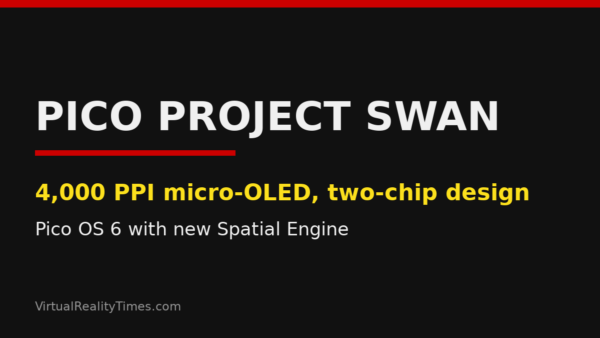
ByteDance’s XR division has put numbers to its next headset. Pico on Monday shared the first official specifications for Project Swan, a high-end device built around micro-OLED displays and a two-chip design, and introduced Pico OS 6, a new operating system that looks squarely aimed at Apple’s visionOS.
Pico first teased a premium headset last November, when a ByteDance technology executive said it would arrive in 2026 with 4000 PPI micro-OLED panels and a dual-chip architecture. Today’s announcement fills in more of that picture, though key details such as price, weight and the name of the main chip supplier are still missing.
The specs
Project Swan uses what Pico calls “new generation” micro-OLED panels with a density of about 4,000 pixels per inch. Pico says that works out to an average of 40 pixels per degree across the view, rising to more than 45 at the centre. The company claims that is sharper than Apple Vision Pro and good enough for reading text on virtual monitors, a use case where many current headsets still struggle.
Compute is split across two chips. The main processor, according to Pico, offers more than twice the CPU and GPU performance of Qualcomm’s Snapdragon XR2 Gen 2, the chip inside the Pico 4 Ultra and Meta Quest 3. Pico did not say who makes it. As UploadVR noted in its coverage, a Snapdragon XR2 Gen 3 is one possibility, but nothing in the announcement confirms that.
The second chip is Pico’s own silicon for computer vision and image processing. Pico says it delivers passthrough and perception with roughly 12 milliseconds of latency, the same figure Apple quotes for the R1 chip in Vision Pro. Hand tracking and eye tracking are both confirmed.
Pico OS 6 and developer tools
The software announcement may matter as much as the hardware. Pico OS 6 is built around a new Pico Spatial Engine, which the company says took about two years to develop. Like visionOS, it uses a system-level compositor that lets ordinary 2D apps and 3D apps run side by side, set against either a virtual environment or the user’s real room. Pico lists environmental lighting, dynamic occlusion, spatial audio, real-world surface collisions and scene understanding as system features. The new design language is called “Cloud Crystal.”
A feature called PanoScreen arranges multiple app windows in a 360-degree space around the user, with support for hands, controllers, and a keyboard and mouse. Standard Android apps are meant to run directly inside immersive scenes rather than as separate flat layers.
For developers, Pico announced a Pico Spatial SDK that works with Android Studio and Kotlin, Pico Spatial support for both Unity and Unreal, and continued support for OpenXR. Pico says apps that run on the Pico 4 Ultra today will run on Project Swan. It is also releasing WebSpatial, an open-source framework that it describes as a minimal extension to HTML, CSS and JavaScript for building spatial web apps.
Release timing and early access
Pico says Project Swan will launch globally later in 2026. Developers can start building with the OS 6 tools now, and Pico has opened a Global Early Access Program, as Road to VR reported, offering a closed beta of both the headset and Pico OS 6 to a hand-picked group of experienced XR users and developers. The company says it wants detailed feedback before a wider release.
Pico also plans a session at GDC 2026 in San Francisco next week, where it says it will cover graphics performance, input, its developer toolchain and how to bring existing apps into spatial computing, with live demos.
How it compares
On paper, Project Swan sits closer to Vision Pro and Samsung’s Galaxy XR than to Meta’s Quest line. Vision Pro set the bar for display sharpness and passthrough latency when it launched in 2024, and Galaxy XR brought Google’s Android XR platform to a micro-OLED headset last October. Pico is now claiming higher pixel density than Vision Pro, matching latency, and a more flexible multitasking model than Meta’s Horizon OS or Android XR, which UploadVR says currently run only one 3D app at a time.
What Pico has not shared will decide how serious a challenger Swan becomes. Price is the obvious gap: micro-OLED panels at this density are expensive, and the global memory shortage is already pushing up hardware costs across the industry. Weight and comfort are also unknown. The Information reported last year that Pico was working on an ultralight headset with a tethered compute puck, but Monday’s graphics showed both chips side by side, so it is unclear whether that design changed or refers to another device.
Pico’s track record outside China is another question. The Pico 4 Ultra sold in Europe and Asia but not in the United States, and Pico has not said which markets Project Swan will reach beyond calling the launch global. For now, Pico has shown a credible spec sheet and a software platform with real ambition. The rest should become clearer at GDC and in the closed beta that follows.
Related coverage on Virtual Reality Times
- Pico Delays Space Pro Headset to Late 2026 and Cancels September Reveal
- visionOS 26.4 Brings Foveated Streaming to Vision Pro, Opening a Door for PC and Cloud VR
- Pico 4 Spring Bundle Features 4 Free VR Games
- Pico Interactive Unveils Its G3 VR Headset
- Pico Delays US Headset Launch Following TikTok Congressional Hearing

Leave a Reply