
Meta Unveils $799 Ray-Ban Display Glasses With Neural Wristband at Connect 2025
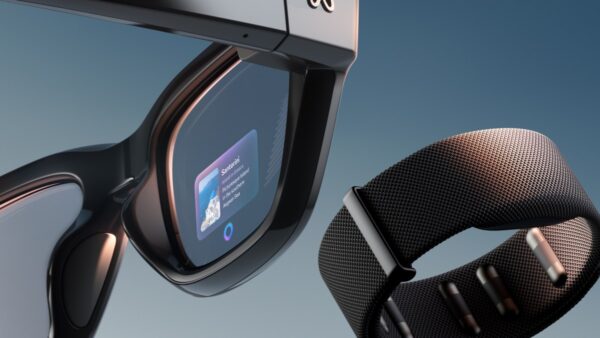
Meta’s smart-glasses strategy took a major step forward at Connect 2025. On September 17, the company introduced Meta Ray-Ban Display, a pair of camera-equipped AI glasses with a built-in full-color visual display, and a companion Meta Neural Band that reads subtle muscle signals at the wrist.
The package starts at $799 in the United States, including the glasses and wristband. Meta says it will reach selected physical retail stores on September 30. It is an unusual product combination: familiar-looking eyewear provides the information, while the wrist supplies an alternative to touching the frame or speaking commands aloud.
Unlike the company’s VR headsets, these glasses are designed for brief interactions while the user remains aware of the surroundings. And unlike its earlier screen-free Ray-Ban smart glasses, they can actually show information in front of the wearer.
A small display rather than a virtual world
The glasses feature a high-resolution color display positioned toward the edge of the wearer’s view. Meta is emphasizing quick glances, not an uninterrupted overlay that fills the world with digital objects.
Demonstrated uses include previewing photos, reading messages, viewing responses from Meta AI, receiving navigation guidance and following live captions or translations during a conversation.
These functions sound modest compared with full augmented reality demonstrations. Their significance lies in the possibility of completing short tasks without repeatedly taking out a phone. A message, for example, can appear as visual information rather than being spoken into an open ear.
Meta is not presenting Ray-Ban Display as an immersive headset or a wide-field holographic AR system. Its visual interface is deliberately narrower. This distinction will matter to anyone comparing specifications or expecting virtual objects fixed throughout a room.
The Neural Band is the other half of the product
Meta Neural Band uses surface electromyography, or EMG, to detect electrical signals generated by muscles. Meta has been researching this type of control for several years, and Connect marks its arrival as part of a consumer product.
The wristband interprets small movements into commands, allowing users to navigate and select items without reaching for the glasses. Meta demonstrated interactions such as swiping and clicking through subtle finger gestures.
This is not mind reading. The system measures activity associated with muscle movements, rather than accessing thoughts. Nevertheless, the control method could become important if smart glasses are to move beyond audio-based assistants.
Spoken commands can be awkward on public transport or in meetings. Touch gestures on the glasses are visible and sometimes inconvenient. A reliable wrist interface creates a third option, though its usefulness will depend on accuracy, comfort and how quickly newcomers learn the movements.
Meta says the band offers up to 18 hours of battery life and an IPX7 water-resistance rating. The company is also positioning it as potentially useful for accessibility, where standard touch gestures may be difficult.
Price, battery and the launch plan
The $799 entry price includes the Neural Band. Meta plans an initial US rollout at selected Best Buy, LensCrafters, Sunglass Hut and Ray-Ban locations rather than an unrestricted global launch.
The company says the glasses provide up to six hours of mixed use, with a case extending total use to 30 hours. Black and Sand are the announced color options, and the eyewear uses Transitions lenses intended for indoor and outdoor use.
An expansion to Canada, France, Italy and the United Kingdom is planned for early 2026. Those locations are future intentions as of today’s announcement, not countries where the glasses can already be purchased.
Requiring in-person fitting and demonstrations may reduce confusion with ordinary camera glasses. Customers are being asked to learn an unfamiliar wrist control system, which gives the retail experience a bigger role than it has for many phone accessories.
Meta’s growing eyewear lineup
The display glasses arrive alongside an updated Ray-Ban Meta (Gen 2) announcement, featuring better battery life and 3K video recording in the screen-free line. The two products show Meta separating everyday camera-and-audio eyewear from a more expensive model with a visual interface.
That differentiation may be useful for buyers. Someone who primarily wants music, photos or voice assistance may not need a display. Another user may see enough value in glanceable information to justify the extra expense and wristband.
For competitors, the larger implication is that Meta is treating eyewear as a product family, not an experimental side project. Optics, software, retail distribution and input methods all have to work together.
A real test of wearable interaction
What Meta has shown is promising, but several questions cannot be answered at a keynote. How consistently does EMG control work during walking? Does the display remain readable in difficult lighting? Can the glasses deliver genuinely useful information without becoming distracting?
The social effects are equally important. A display near one eye can make a device seem less isolating than a headset, but a camera and AI assistant still raise privacy and etiquette questions.
The immediate story is concrete: Meta has announced a $799 product with a display and a new input method, and has set a US retail date. The longer-term question is whether that combination is convenient enough to become part of ordinary daily life.
Related coverage on Virtual Reality Times
- Meta Opens Hyperscape Capture Early Access, Letting Quest Users Recreate Real Rooms in VR
- Oakley Meta HSTN Brings AI Glasses Into Sports With 3K Video and Longer Battery Life
- Third-Generation Ray-Ban Stories Shipping in 2025, to Feature a Neural Wristband and HUD
- Facebook and Ray-Ban’s ‘Stories’ First Smart Glasses Not Breakthrough Devices
- Facebook and Ray-Ban Unveil $299 Ray-Ban Stories Smart Glasses
Sources
https://virtualrealitytimes.com/2025/09/17/meta-unveils-799-ray-ban-display-glasses-with-neural-wristband-at-connect-2025/https://virtualrealitytimes.com/wp-content/uploads/2025/09/meta-ray-ban-display-2025-09-17-600x338.jpghttps://virtualrealitytimes.com/wp-content/uploads/2025/09/meta-ray-ban-display-2025-09-17-150x90.jpgAR HeadsetsAugmented RealityMetaAR smart glasses,EMG wristband,Meta Connect 2025,Meta Neural Band,Meta Ray-Ban DisplayMeta's smart-glasses strategy took a major step forward at Connect 2025. On September 17, the company introduced Meta Ray-Ban Display, a pair of camera-equipped AI glasses with a built-in full-color visual display, and a companion Meta Neural Band that reads subtle muscle signals at the wrist. The package starts at...Virtual Reality Times [email protected]SubscriberVirtual Reality Times
Leave a Reply