
Reality Labs Loses $4.21 Billion in Q1 2025 as Revenue Falls Year Over Year
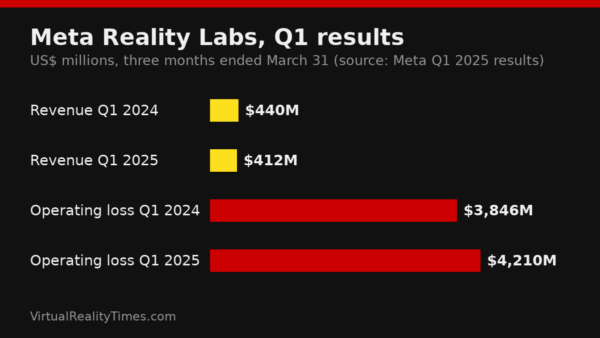
Meta’s Reality Labs division began 2025 with another substantial operating deficit. The company’s April 30 earnings release reports $412 million in Reality Labs revenue for the first quarter and a $4.210 billion operating loss, widening the division’s year-over-year loss despite the broader company’s profitability.
The figures show the scale of the gap between Meta’s investments in immersive computing and the revenue its XR business currently generates. Reality Labs includes VR, AR and mixed reality hardware, software and services, so the segment numbers describe the overall initiative rather than a single product such as Quest.
For the wider XR industry, the report is a useful reminder that headline product launches and impressive technical demonstrations do not by themselves establish financial sustainability.
The numbers behind the quarter
Reality Labs revenue fell from $440 million in the first quarter of 2024 to $412 million in the same period this year. Its operating loss increased from $3.846 billion to $4.210 billion.
Those changes are directionally different: a modest decline in revenue coincided with a larger loss. However, investors and consumers should avoid interpreting the figures as proof of a specific number of headsets sold. Meta does not provide a complete product-by-product revenue breakdown within the segment table.
The quarter also follows a much stronger holiday period. Reality Labs generated more than $1 billion in fourth-quarter 2024 revenue, a seasonal comparison that makes a direct quarter-to-quarter reading less informative than comparing the same period across years.
Meta’s reported operating loss is also not identical to the amount of cash spent buying components for headsets. It includes broader research, engineering and operating costs, some of which are aimed at products or services years from commercial availability.
Why advertising profits change the calculation
Meta’s larger business remains highly profitable. In the first quarter, it recorded $42.314 billion in total revenue and $17.555 billion in operating income. The Family of Apps division generated $21.765 billion in operating income before Reality Labs’ deficit.
That financial structure allows Meta to sustain a research program that would be difficult for a standalone headset maker to finance. Advertising revenue from Facebook, Instagram and other services gives the company room to experiment with hardware, operating systems, developer ecosystems and long-term display technologies.
Competitors do not all have the same luxury. A smaller company may have to generate attractive margins on each headset or accessories to remain viable. Meta can pursue market growth and platform ownership while absorbing losses that would overwhelm a much smaller firm.
The strategy still has a cost. Money allocated to an emerging platform is money not invested elsewhere, and shareholders will continue asking how Meta measures progress toward a sustainable business.
Quest and smart glasses serve different users
Reality Labs spans several product categories with distinct reasons to exist. Quest is built around immersion: stereoscopic displays, tracked hands and controllers, positional audio and the ability to place virtual objects or entire scenes around a user.
Smart glasses pursue a different everyday proposition. They must be comfortable and socially acceptable for long periods, while providing enough utility through cameras, audio or AI assistance to justify wearing them. They are not substitutes for fully immersive VR, even though both categories can contribute to a broader spatial computing strategy.
Combining those efforts in financial reporting makes the company difficult to evaluate through traditional product comparisons. Growth in one category could coexist with weaker performance in another. Conversely, high research spending in glasses might be recorded in the same segment as revenue from Quest hardware or software.
The aggregate figures should therefore be treated as a measure of Meta’s combined XR business, not as an independent verdict on any single device.
What developers will watch
For software studios, the most important business question is whether the installed audience is spending money and returning regularly. A headset platform can have ambitious technology and substantial marketing without giving every developer a viable route to revenue.
Discoverability, store recommendations, pricing controls and platform policies influence that outcome. So do the size and habits of the audience: a fitness subscriber, a multiplayer game regular and a high-end productivity user may spend money in very different ways.
Meta has the resources to keep improving those systems, but the wider economic challenge remains. New hardware needs appealing software, and studios need enough commercial success to keep producing that software.
A long investment cycle with no simple answer
The first-quarter report does not establish that Meta’s investments are failing, nor does it prove they will eventually pay off. It records the present financial reality of a business still building products and infrastructure ahead of its revenue base.
In the months ahead, new software releases, improvements to the Quest experience and developments in smart glasses may provide better information about adoption and engagement. Earnings will then show whether those advances are translating into durable business results.
For now, the $4.21 billion quarterly operating loss stands as a stark indicator of how aggressively Meta is still funding the future it imagines for XR.
Related coverage on Virtual Reality Times
- Meta Reality Labs Posts $4.97 Billion Quarterly Loss as XR Spending Continues
- Meta Reality Labs Reports $4.53 Billion Q2 Loss as Revenue Reaches $370 Million
- Meta’s Reality Labs Posted $3.99 Billion First Quarter Loss
- Meta’s Reality Labs Lost $13.7 Billion in 2022
- Report: Roughly 20% of Meta Staff Working in its Reality Labs Division

Leave a Reply