
Meta Reality Labs Reports $4.53 Billion Q2 Loss as Revenue Reaches $370 Million
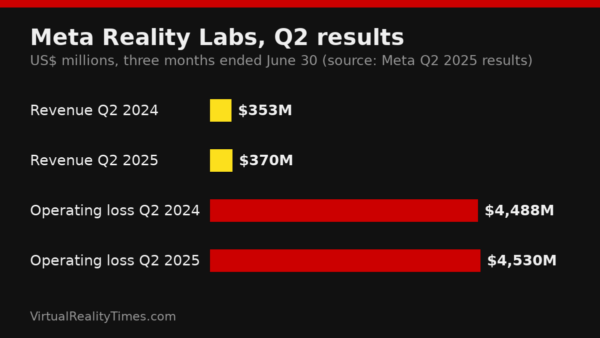
Meta’s XR ambitions remain a substantial financial investment. In results released July 30, the company reported $370 million in second-quarter Reality Labs revenue and an operating loss of $4.530 billion for the business that includes its virtual reality, mixed reality and augmented reality activities.
The loss was slightly larger than the $4.488 billion recorded in the same quarter of 2024, while revenue increased from $353 million a year earlier. On a six-month basis, Reality Labs generated $782 million in revenue and accumulated an $8.739 billion operating loss.
The numbers underline a recurring tension in XR: companies are building expensive new hardware and software platforms while consumer adoption and monetization remain far smaller than those of mature technology businesses.
A modest revenue gain against heavy spending
Reality Labs’ revenue rose year over year, but the increase was small compared with the division’s ongoing operating costs. The company’s public results do not provide a complete division-wide breakdown of how much revenue came from headsets, glasses, games, subscriptions or other activities.
That limits what can reliably be concluded about product demand. For example, it would be inaccurate to say the results prove a specific decline in Quest headset sales or reveal exactly how many smart glasses were purchased without separate supporting information.
There are also seasonal patterns in consumer electronics. Hardware revenue can vary substantially around holiday shopping periods, so an isolated summer quarter should not be compared directly with a year-end quarter as if buying behavior remained constant.
What can be said confidently is that the business continues to operate at a loss far above its current revenue.
Meta can afford a strategy competitors cannot
Meta reported $47.516 billion in total second-quarter revenue, supported overwhelmingly by its advertising-based Family of Apps business. That segment recorded $24.971 billion in operating income, while Reality Labs’ losses reduced consolidated operating results.
This structure gives Meta an unusual advantage. It can invest in headset operating systems, software tools, optics, research and new wearables long before those projects generate profits of their own.
Smaller hardware vendors do not necessarily have that option. A company whose primary business is selling headsets may need to earn more from each device, limit research spending or depend on outside capital.
Such differences shape competition. Meta can pursue a lower-priced device or fund exclusive content partly because its overall business has other sources of profit. At the same time, investors may eventually demand clearer evidence that XR spending will lead to an economically sustainable business.
Quest and glasses are becoming distinct bets
The Reality Labs label covers an increasingly broad range of technologies. Quest emphasizes immersive experiences, tracking and mixed reality. Smart glasses aim for more continuous, everyday use through audio, cameras and AI assistance.
Those devices have different customer needs and technical constraints. A headset may be judged on display resolution, controller response and the available game library. Everyday glasses are judged on comfort, appearance, battery life and whether they solve problems without making the wearer feel conspicuous.
The products also have different software markets. A VR game is often purchased for a dedicated session; a wearable assistant might become valuable through many small interactions throughout the day.
Combining the categories in one financial segment makes sense organizationally, but outside observers should avoid assuming that a single quarterly result describes the health of each individual product line.
The software economy matters as much as devices
A sustainable VR market requires developers to earn enough to support future releases. Device sales can introduce users to the ecosystem, but ongoing spending on software and services gives them reasons to keep using it.
Meta has been experimenting with store discovery, content feeds and creator tools. Those efforts are not glamorous compared with a headset reveal, yet they influence whether a small studio can find customers.
The company must also decide how much first-party content to finance and how to balance premium games with social experiences, fitness and mixed reality applications. Each category has its own revenue patterns and development costs.
An ecosystem may appear healthy from the number of available apps while still failing to generate enough income for many of the teams that create them. The financial performance of the platform and the financial performance of an individual developer are related but not identical.
What to watch through the second half
Future product launches, new software and changes to the Quest experience may provide evidence about Meta’s direction. Investors will continue monitoring losses, while consumers are more likely to judge the products on value, convenience and what they can do with them.
The wider market is also evolving, with Apple and Android XR-related efforts establishing alternative platforms and manufacturers exploring lighter display hardware.
For now, Meta’s second-quarter report shows a company willing to continue spending billions on XR even as its current division revenue remains measured in hundreds of millions. That financial commitment has helped shape the consumer VR market, but the question of when the investment produces sustainable returns remains unanswered.
Related coverage on Virtual Reality Times
- Reality Labs Loses $4.21 Billion in Q1 2025 as Revenue Falls Year Over Year
- Meta Reality Labs Posts $4.43 Billion Q3 Loss Despite Higher XR Revenue
- Meta’s Reality Labs Posted $3.99 Billion First Quarter Loss
- Meta’s Reality Labs Lost $13.7 Billion in 2022
- Report: Roughly 20% of Meta Staff Working in its Reality Labs Division

Leave a Reply