
Apple Previews visionOS 26 With Spatial Widgets, Better Personas and PS VR2 Controllers
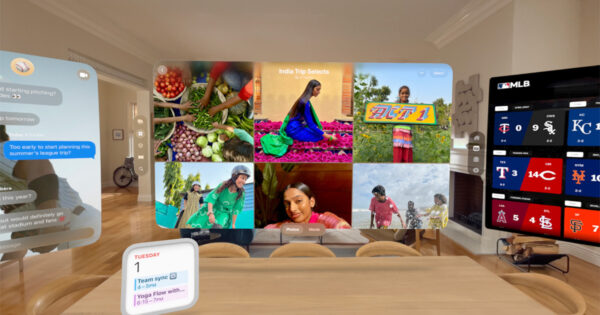
Apple is using WWDC25 to make Vision Pro feel more like a computing environment that remains organized around the user. Announced June 9, visionOS 26 introduces spatial widgets that can be placed in a room, improved digital Personas, new ways to create depth from photographs and support for PlayStation VR2 Sense controllers.
The update illustrates Apple’s effort to address both practical and experiential weaknesses of early spatial computing. A headset may be capable of displaying large virtual screens, but its daily usefulness depends on how quickly users find their tools and how naturally they can interact with people and digital objects.
visionOS 26 is a software preview rather than a new hardware announcement. The features are being shown to developers before their wider availability, and buyers should not assume every announced capability is already present on all existing installations.
Widgets that stay where users put them
Traditional widgets are compact information panels displayed on a phone or computer desktop. visionOS 26 extends the idea into physical space. Apple says users will be able to position clocks, photographs, music controls and other widgets around their environment, with those placements available again when they wear Vision Pro.
The feature could change how users think about spatial interfaces. Instead of opening a central app launcher for every small task, someone might keep a clock near a desk, a favorite photograph on a wall or a music control within easy reach.
That sounds simple, but persistence is important. A spatial interface becomes more useful when the arrangement reflects a user’s habits and does not have to be reconstructed each session.
Developers will also gain opportunities to create spatial widgets using Apple’s existing framework approach. The value will depend on whether applications present information in compact, glanceable forms rather than filling a room with unnecessary windows.
Personas become more expressive
Apple is also revising Personas, the digital representations used to communicate with people in Vision Pro. The company says the new versions offer improved detail and more convincing hair, eyelashes, skin and facial expression, while still allowing users to create a Persona using the headset.
Remote communication is one of spatial computing’s more difficult promises. A virtual image of a person’s face can enable conversation while both participants wear devices that conceal their actual expressions. But if that representation looks unnatural, the experience may feel less personal rather than more.
Better fidelity could help reduce that gap. Apple also announced improvements to shared spatial experiences, including the ability for Vision Pro users in the same physical room to participate in activities together and to include remote participants in supported situations.
The precise social value of those improvements will depend on how many people use compatible hardware and applications. A communication feature has limited reach if few friends or colleagues can join it.
Photos gain spatial depth
A new Spatial Scenes capability uses computational techniques, including generative AI, to add depth and multiple perspectives to ordinary images. Instead of simply viewing a photograph as a flat panel, users may be able to lean and see a more dimensional interpretation.
This should not be confused with recovering all of the real three-dimensional information that existed when the photo was taken. A single flat image contains incomplete depth data, so software must estimate parts of the scene. The result can be evocative without being a precise reconstruction.
For personal photos, that distinction may matter less than the emotional experience. For technical uses such as measurement or engineering, it would matter much more.
Apple is also expanding support for immersive video formats from cameras and systems including Insta360, GoPro and Canon, reinforcing Vision Pro’s role as a high-end media viewing platform.
An unexpected opening for games
The addition of PS VR2 Sense controller support is one of the most consequential announcements for developers. Apple has largely emphasized eyes, hands and voice as natural inputs, but many games benefit from tactile buttons, precise tracking and deliberate physical controls.
Supporting an established controller type may make it easier to bring certain styles of interactive content to Vision Pro. It does not mean that the entire PlayStation VR2 catalog becomes playable on Apple’s headset; each game would still require compatible software and platform support.
The announcement is also an acknowledgment that natural input is not always the best option for every task. Fast action games, for example, may need a different control language from productivity software.
A more mature spatial interface
visionOS 26 is not built around one revolutionary feature. Its significance comes from a collection of changes that make Apple’s spatial computing concept more practical: persistent interface elements, clearer communication, richer media and broader input choices.
The unanswered questions remain substantial. Vision Pro is expensive, physically demanding for some users and supported by an ecosystem still finding its most useful everyday applications. Software cannot erase all those limitations.
It can, however, make the headset more useful for people who already own one and provide stronger foundations for developers considering the platform. At WWDC25, Apple is showing that the evolution of spatial computing may depend as much on refining everyday interactions as on adding more pixels.
Related coverage on Virtual Reality Times
- Apple Upgrades Vision Pro With M5 Chip and New Dual Knit Band, Keeps $3,499 Starting Price
- Sony Cuts PlayStation VR2 to $399.99 in Major Price Reset
- Controlling the Apple Vision Pro Headset With Eyes and Hands
- Apple to Open Several Vision Pro Developer Labs in Multiple Cities To Test Headset
- Apple Vision Pro Headset Details: Specs, Release Date, Price, and More

Leave a Reply