
Meta Reality Labs Posts $4.43 Billion Q3 Loss Despite Higher XR Revenue
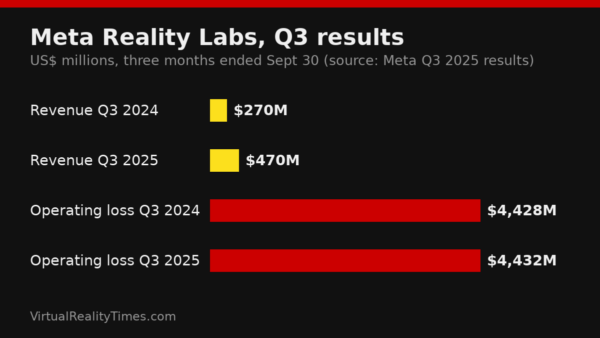
Meta’s immersive-technology division is bringing in more money, but its losses remain enormous. In results announced October 29, Reality Labs reported $470 million in third-quarter 2025 revenue and an operating loss of $4.432 billion.
Revenue increased from $270 million in the same quarter a year earlier. Yet the operating loss was almost unchanged compared with the $4.428 billion recorded in the third quarter of 2024.
Those two trends capture the central tension of Meta’s extended bet on virtual reality, mixed reality and smart glasses. The company is building products and an ecosystem that now generate measurable commercial activity, but the financial cost continues to dwarf the revenue attributed to the division.
The numbers behind the headline
Meta’s official quarterly statement records the following Reality Labs results:
- Q3 2025 revenue: $470 million, compared with $270 million in Q3 2024.
- Q3 2025 operating loss: $4.432 billion, compared with $4.428 billion a year earlier.
- First nine months of 2025 revenue: $1.252 billion.
- First nine months of 2025 operating loss: $13.171 billion.
The nine-month figures are particularly important. They show that the losses are not an isolated bad quarter but part of a sustained investment program involving hardware, software, research and supporting operations.
An operating loss also should not be confused with cash spent on one specific product line. Reality Labs encompasses a range of activity, and its segment reporting does not reveal an independent profit figure for each headset or pair of glasses.
It would be misleading to divide the loss by an estimated number of Quest customers and describe the result as the subsidy on each device.
Revenue growth needs careful interpretation
The increase from $270 million to $470 million is notable, particularly for a division operating in categories where consumer adoption has been uneven. However, revenue growth by itself does not establish that the Quest platform has suddenly accelerated or that smart glasses account for a particular proportion of sales.
Meta’s reporting groups several XR-related businesses within Reality Labs. It does not provide a detailed breakdown sufficient to isolate every contribution from glasses, headsets, services or other products.
The company also says retail partners purchased Quest units during the third quarter to prepare for the holiday season, a factor that affected the timing of recognized revenue. Sales into a retail channel should not be automatically equated with products already purchased and used by consumers.
That timing can make quarterly comparisons especially difficult. Headset shipments, store inventory and end-user demand do not always move in lockstep.
The wider Meta business is a different story
Reality Labs is part of a much larger company. Meta’s Family of Apps business, which includes Facebook, Instagram, WhatsApp and Messenger, continues to generate substantial revenue and operating income.
That broader earnings base allows Meta to finance unusually expensive long-term hardware projects. A smaller independent VR company could not sustain comparable quarterly operating losses for years while waiting for the market to mature.
The arrangement has benefits and drawbacks for the XR industry. Meta’s investment supports devices, developer tools and distribution infrastructure that smaller companies can build upon. At the same time, the division’s scale and spending can make competition difficult for firms without similar resources.
A more diverse XR market would benefit from profitable opportunities that do not require every participant to operate at Meta’s financial scale.
Quest, smart glasses and the future platform question
Meta’s hardware strategy spans both immersive headsets and lighter everyday eyewear. Quest devices are designed for VR and mixed reality, where a user wears displays that take over or augment the surrounding view.
Its smart-glasses products emphasize photography, audio, assistants and, in the new Ray-Ban Display model, a smaller visual interface.
These categories have different purchase motivations and usage patterns. Someone may wear glasses throughout a day but reserve a headset for a dedicated game, workout or work session. Revenue growth in one category does not automatically solve adoption problems in the other.
For developers, the mix creates uncertainty about where future audiences will gather. A VR game studio cannot assume a smart-glasses purchaser will buy immersive games, and a software company targeting glanceable AI interactions may not need headset-specific controls.
How to judge progress from here
Quarterly losses alone do not tell us whether particular technologies have long-term potential. New computing platforms can require years of investment before their economic prospects become clear.
But the reverse is equally true: large expenditures do not guarantee that a category will eventually become profitable. Meta must still prove that enough customers want these products, use them repeatedly and support a viable software and services ecosystem.
Future results can help answer questions about hardware sales, sustained demand, operating expenses and the share of revenue coming from different products if Meta chooses to disclose more detail.
For the third quarter, the evidence is unambiguous. Reality Labs increased revenue substantially year over year, while recording another loss of more than $4.4 billion. The business remains an ambitious investment in what Meta hopes will become a major computing platform, not a self-funding operation today.
Related coverage on Virtual Reality Times
- Meta Reality Labs Reports $4.53 Billion Q2 Loss as Revenue Reaches $370 Million
- Reality Labs Loses $4.21 Billion in Q1 2025 as Revenue Falls Year Over Year
- Meta’s Reality Labs Posted $3.99 Billion First Quarter Loss
- Meta’s Reality Labs Lost $13.7 Billion in 2022
- Report: Roughly 20% of Meta Staff Working in its Reality Labs Division

Leave a Reply