
Even Realities Reaches $1 Billion Valuation With $150 Million Smart Glasses Funding
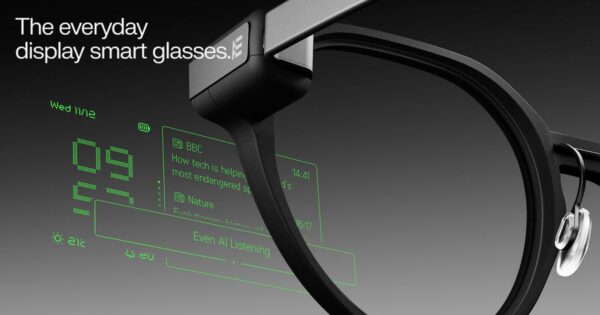
Smart glasses startup Even Realities has joined the billion-dollar club without embracing the camera-first design favored by many of its larger rivals. The Shenzhen-based company raised $150 million in a pre-Series B financing round, according to reports published July 6, valuing the business at $1 billion and providing new capital for its next generation of display-equipped eyewear.
The financing was led by Chinese technology companies Meituan and Tencent, with Tencent returning as an investor. TechCrunch reports that founder and CEO Will Wang, a former Apple employee, is positioning Even Realities around a relatively specific proposition: put useful information in a person’s field of view without turning everyday glasses into an always-ready camera.
That approach offers a revealing contrast to the way the smart glasses market is developing. Some companies want eyewear to become the next way to capture video and talk to an AI assistant. Even Realities is betting that discreet visual information may be the stronger reason to wear the devices all day.
A different answer to the camera question
The company’s Even G2 glasses use binocular, monochrome green displays. Unlike products that place a camera on the frame, G2 leaves that component out. The wearer can receive information in front of their eyes, but the product is not designed around photographing or filming surrounding people.
The omission has practical consequences beyond privacy. It limits the kinds of visual AI functions the glasses can perform on their own. A camera-equipped device might identify a landmark or interpret what is on a restaurant menu. Camera-free glasses instead emphasize delivering information through displays while depending on other devices, sensors or user input for context.
Neither design is automatically better. People who want hands-free photos will prefer one kind of device. People who dislike having a camera on their face, or who work in environments sensitive to recording, may value the other. Even Realities appears to believe this distinction is important enough to build an entire product identity around it.
The Even R1 smart ring adds another element to the company’s interface strategy. Rather than relying exclusively on touch controls on a glasses frame or spoken commands, the ring offers a separate way to interact with the system. That could prove useful when speaking to glasses in public would be awkward, although real-world usefulness depends on comfort and software execution.
What $150 million could buy
A large funding round gives a hardware startup options that smaller rivals often lack. Designing frames, miniature displays, optics and batteries is expensive; so are manufacturing preparation, distribution, after-sales support and the software needed to make a wearable device genuinely useful.
Even Realities says the money will go toward its next-generation glasses platform, deeper AI integration and expansion of global operations. It has not announced every feature or release date for future products, so the investment should not be mistaken for confirmation of a specific new model.
The company has reportedly raised approximately $159 million in total. A $1 billion valuation places it among a relatively small number of startups that investors believe may become substantial businesses, but that number represents the value implied by a financing transaction, not annual sales or proof of profitability.
Those distinctions are especially important in an emerging hardware category. Investor interest can accelerate research and manufacturing, but consumer behavior eventually determines whether the business can sustain itself.
The United States is central to the story
CNBC reports that more than half of Even Realities’ users are in the United States. For a China-headquartered company, that international customer mix helps explain the emphasis on global expansion and the importance of competing on design and user experience, not merely on manufacturing cost.
The wider competition is formidable. Meta has built recognition for camera-enabled smart eyewear. Google and Samsung are developing an Android XR ecosystem for AI-powered glasses, while Snap is pursuing more ambitious visual AR through its new Specs product. Each company is trying to answer what people will want to do once computing moves off the phone.
Even Realities does not have the same consumer platform, retail footprint or marketing resources as those giants. Its opportunity is sharper focus. A relatively unobtrusive display that solves small, repeated problems could be valuable without reproducing the entire smartphone experience.
A bet on information rather than spectacle
Smart glasses are often discussed as though they are all early versions of the same futuristic product. In practice, the field already includes camera glasses, information displays, full augmented reality and devices that mainly function as wearable audio assistants.
Even Realities’ financing suggests investors see meaningful commercial potential in one of those narrower categories. The company is not claiming to deliver fully immersive virtual worlds in ordinary frames. It is offering a screen people can consult without looking down at a phone.
Whether that becomes a mainstream habit will depend on visibility, battery life, software, comfort and a price consumers will accept. Today’s funding round cannot answer those questions. It does, however, show that the future of smart glasses may be contested by fundamentally different designs, not simply by better versions of the same camera-equipped product.
Related coverage on Virtual Reality Times
- Snap Opens Preorders for $2,195 Standalone Specs AR Glasses at AWE 2026
- Samsung Shows New Android XR Smart Glasses Designs With Google and Eyewear Partners
- Ostloong Innovations’ LYRA AR Smart Glasses Fuse AR and AI
- Google Stops Sales of its Glass Enterprise Smart Glasses
- Huawei Launches Smart Vision VR Glasses
Sources
https://virtualrealitytimes.com/2026/07/06/even-realities-reaches-1-billion-valuation-with-150-million-smart-glasses-funding/https://virtualrealitytimes.com/wp-content/uploads/2026/07/even-realities-2026-07-06-600x315.jpghttps://virtualrealitytimes.com/wp-content/uploads/2026/07/even-realities-2026-07-06-150x90.jpgAR HeadsetsBusinessStartupsAI glasses,Even G2,Even Realities,smart glasses funding,wearable displaySmart glasses startup Even Realities has joined the billion-dollar club without embracing the camera-first design favored by many of its larger rivals. The Shenzhen-based company raised $150 million in a pre-Series B financing round, according to reports published July 6, valuing the business at $1 billion and providing new...Virtual Reality Times [email protected]SubscriberVirtual Reality Times
Leave a Reply