
Meta Reality Labs Posts $4.62 Billion Quarterly Loss Despite Higher Revenue
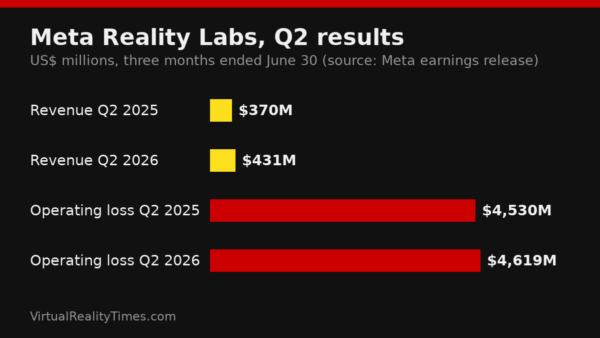
Meta’s virtual and augmented reality business generated more revenue in the second quarter of 2026, but its operating losses continued to dwarf the money coming in. The company’s July 29 financial results show Reality Labs revenue of $431 million and an operating loss of $4.619 billion for the three months ended June 30.
The figures offer a stark measure of the cost of trying to build a new computing platform. Meta sells headsets and develops software, virtual experiences and smart glasses, but it is also paying for research and infrastructure intended to support products that may not reach mass audiences for years.
According to Meta’s earnings release, Reality Labs’ quarterly revenue rose from $370 million in the comparable period of 2025. At the same time, its operating loss widened from $4.530 billion. Growth in sales did not translate into operating profitability.
The numbers behind the headline
Revenue increased by $61 million year over year, approximately 16.5%. The operating loss grew by $89 million, or roughly 2%. That comparison suggests the division made some revenue progress without materially changing its overall financial position.
Operating loss should not be confused with a simple cash payment or a count of unsold headsets. It reflects the division’s reported revenue minus the expenses allocated to its operations during the period. Research, engineering, staffing and other costs can affect the result independently of how many devices sell in a quarter.
The contrast with Meta’s main business is enormous. Family of Apps, which includes Facebook, Instagram and WhatsApp, reported $60.37 billion in revenue and $23.394 billion in operating income for the quarter. Reality Labs, by comparison, represents a much smaller current revenue stream attached to very large development expenditure.
Meta’s total company revenue reached $60.801 billion. The profitable advertising-supported ecosystem therefore continues to provide the economic foundation for much of the company’s long-term experimentation in immersive technology.
What the results do not reveal
It is tempting to attribute every change in Reality Labs revenue to a specific product, such as Quest headsets or Ray-Ban smart glasses. The division’s published segment figure, however, combines virtual and augmented reality hardware, software and content. The $431 million total does not, by itself, establish the unit sales or profitability of individual products.
That matters as Meta increasingly discusses AI-powered eyewear alongside conventional VR. Smart glasses and immersive headsets can appeal to different customers, carry different margins and require different forms of software support. A rise in division revenue does not prove that one category is compensating for weakness in another.
Analysts can compare the report with company commentary and retailer data, but those are additional sources with their own limitations. The cleanest finding from today’s disclosure is the division-wide result, not a precise explanation of product-level demand.
The strategic argument behind continued losses
Meta has spent years arguing that immersive computing could become a major platform for communication, entertainment and work. Building that platform requires investment in displays, tracking, optics, input methods, developer tools and operating software before there is any certainty about consumer adoption.
The company is also placing increasing emphasis on AI, which may alter how wearable devices are used. Lightweight smart glasses could reach people unwilling to wear a VR headset for extended periods. Conversely, a deeper immersive system may remain more compelling for games, simulations and experiences that need stereoscopic environments.
For Meta, the strategic challenge is to develop both possibilities without allowing the cost of experimentation to overwhelm the commercial opportunity. That requires patience from investors as well as evidence that products can move beyond enthusiastic early adopters.
How large is the commitment?
Financial coverage has placed Reality Labs’ cumulative operating losses since late 2020 at more than $80 billion. The exact total depends on the period being measured, but the magnitude is unambiguous: this is one of the technology industry’s most expensive bets on a future user interface.
It is nevertheless misleading to interpret the accumulated losses as the price of a single headset generation. The division encompasses work whose benefits, if any, may appear across several product categories and future years. The same research might improve tracking, glasses displays or developer tools in different contexts.
That is the long-term argument. The short-term accounting remains severe. A quarterly operating loss exceeding $4.6 billion means Reality Labs is still nowhere close to supporting itself through its reported revenue.
Investors and developers will now look toward Meta’s next hardware and software announcements for evidence of where spending is producing tangible results. Today’s report does not settle whether the company’s XR strategy will succeed. It does confirm the scale of the financial burden, and the willingness of Meta’s core business to keep funding it.
Related coverage on Virtual Reality Times
- Meta Unveils $1,299.99 VR Glasses at Connect 2026, Shipping Spring 2027
- Sony Transfers XR Patent Rights to Meta, but PS VR2 Implications Remain Unclear
- Meta’s Reality Labs Posted $3.99 Billion First Quarter Loss
- Meta’s Reality Labs Lost $13.7 Billion in 2022
- Report: Roughly 20% of Meta Staff Working in its Reality Labs Division
Sources
https://virtualrealitytimes.com/2026/07/29/meta-reality-labs-posts-4-62-billion-quarterly-loss-despite-higher-revenue/https://virtualrealitytimes.com/wp-content/uploads/2026/07/reality-labs-loss-2026-07-29-600x338.pnghttps://virtualrealitytimes.com/wp-content/uploads/2026/07/reality-labs-loss-2026-07-29-150x90.pngBusinessMetaAR business,Meta earnings,Meta Reality Labs,Q2 2026,VR industryMeta's virtual and augmented reality business generated more revenue in the second quarter of 2026, but its operating losses continued to dwarf the money coming in. The company's July 29 financial results show Reality Labs revenue of $431 million and an operating loss of $4.619 billion for the three...Virtual Reality Times [email protected]SubscriberVirtual Reality Times
Leave a Reply