
Meta Reality Labs Loses $4.03 Billion in Q1 2026, a Smaller Loss Than Wall Street Expected
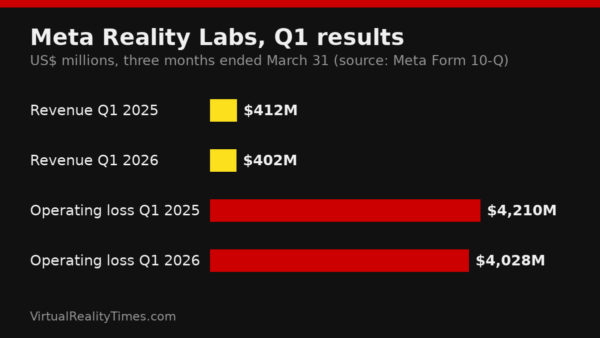
Meta’s virtual and augmented reality division lost a little over $4 billion in the first three months of 2026. That is still a very large number, but it came in below what analysts had pencilled in and slightly below the same quarter last year, a sign that January’s cuts at Reality Labs are starting to show up in the accounts.
Meta reported its first quarter results after the market closed on Wednesday, April 29. Reality Labs, the segment that makes Quest headsets, runs the Horizon platform and builds the Ray-Ban Meta glasses with EssilorLuxottica, posted an operating loss of $4.03 billion on revenue of $402 million.
The numbers
According to CNBC’s report on the results, analysts had expected Reality Labs to lose about $4.82 billion on sales of roughly $488.8 million. So the division lost around $800 million less than forecast, while also bringing in less money than forecast.
Meta’s quarterly filing with the Securities and Exchange Commission gives the precise figures. In its Form 10-Q for the quarter ended March 31, the company puts the Reality Labs operating loss at $4,028 million, compared with $4,210 million in the first quarter of 2025. That is a decline of $182 million, or about 4 percent.
Reality Labs costs and expenses came to $4.43 billion for the quarter, down from $4.62 billion a year earlier, also a drop of roughly 4 percent.
By most tallies, the division has now lost more than $80 billion since late 2020, a running total that keeps growing every quarter even when an individual result beats expectations.
Layoffs show up in costs
Meta’s filing is direct about why spending fell. It says Reality Labs costs “decreased primarily due to a decrease in employee compensation.”
That lines up with the restructuring Meta carried out in January, when it cut roughly 10 percent of Reality Labs staff and closed three first-party VR game studios: Twisted Pixel, Sanzaru Games and Armature Studio. At the time, Meta said it was shifting some of its investment away from the metaverse and toward AI glasses and wearables. It also moved the fitness app Supernatural into maintenance mode and wound down Horizon Workrooms.
The first quarter is the first full reporting period since those changes. A 4 percent cut in costs is modest given the size of the January reductions, but layoffs typically take time to flow through, and severance and other one-off costs can blunt the savings in the near term.
Meta did not break out a separate Reality Labs headcount in the filing. Across the whole company, it reported 77,986 employees as of March 31, up 1 percent from a year earlier, reflecting continued hiring in AI even as the VR side shrank.
Revenue down, and the reason is Quest
Revenue was the weaker part of the picture. At $402 million, Reality Labs sales were down $10 million, or about 2 percent, from $412 million in the first quarter of 2025.
The 10-Q explains the split plainly: the decline “was driven by lower Meta Quest sales, offset by an increase in sales of AI glasses.” In other words, headset sales fell faster than glasses sales grew.
That is not a surprise. Meta did not release a new Quest headset in 2025, and the first quarter is seasonally slow after the holiday period. Earlier this month the company also announced price increases for Quest 3 and Quest 3S, citing higher component costs, which took effect on April 19, after the quarter closed. Any effect of those increases on demand will not appear until next quarter’s numbers.
The glasses business, by contrast, has been growing. EssilorLuxottica said in February that it sold more than 7 million Meta glasses in 2025. Because Meta records only its share of that business, and because glasses sell at much lower prices than headsets, the growth has not been enough to lift overall Reality Labs revenue.
Spending shifts to AI
For investors, Reality Labs was a side story on Wednesday. Meta’s company-wide revenue grew strongly, but it also raised its 2026 capital expenditure forecast to between $125 billion and $145 billion, up from the $115 billion to $135 billion range it gave in January. Meta pointed mainly to higher component prices, and to a lesser extent extra data center costs. Shares fell more than 6 percent in after-hours trading, according to Investing.com, as the spending outlook overshadowed the results.
Much of that spending goes to AI data centers, but it matters for XR too. Meta has made AI the main selling point of its glasses, and the same memory and component price pressures that pushed up its capital budget are the ones it cited when it raised Quest prices.
What it means for headsets and glasses
Taken together, the first quarter numbers describe a division in transition. Headset sales are falling, glasses sales are rising, and Meta is spending less on people inside Reality Labs while spending far more on AI infrastructure across the company.
For Quest owners and VR developers, the takeaway is mixed. Meta is still losing about $4 billion a quarter on Reality Labs, which shows it has not walked away from the category. But the filing makes clear that the growth Meta can point to is coming from glasses, not headsets, and that the savings are coming from a smaller workforce.
Meta has not announced a new Quest headset for 2026. Its next major hardware update is expected at its Connect conference later in the year, and the second quarter results, expected in late July, will be the first to reflect the higher Quest prices.
Related coverage on Virtual Reality Times
- Meta Reality Labs Posts $4.62 Billion Quarterly Loss Despite Higher Revenue
- Meta Cuts About 10% of Reality Labs and Closes Three VR Game Studios
- Meta’s Reality Labs Posted $3.99 Billion First Quarter Loss
- Meta’s Reality Labs Lost $13.7 Billion in 2022
- Report: Roughly 20% of Meta Staff Working in its Reality Labs Division
Sources
https://virtualrealitytimes.com/2026/04/30/meta-reality-labs-loses-4-03-billion-in-q1-2026-a-smaller-loss-than-wall-street-expected/https://virtualrealitytimes.com/wp-content/uploads/2026/04/reality-labs-loss-2026-04-30-600x338.pnghttps://virtualrealitytimes.com/wp-content/uploads/2026/04/reality-labs-loss-2026-04-30-150x90.pngBusinessMetaearnings,Meta,Meta Quest,Reality Labs,smart glassesMeta's virtual and augmented reality division lost a little over $4 billion in the first three months of 2026. That is still a very large number, but it came in below what analysts had pencilled in and slightly below the same quarter last year, a sign that January's cuts...Virtual Reality Times [email protected]SubscriberVirtual Reality Times
Leave a Reply