
Marvel’s Deadpool VR Launches on Quest 3 With Neil Patrick Harris and Chaotic Combat
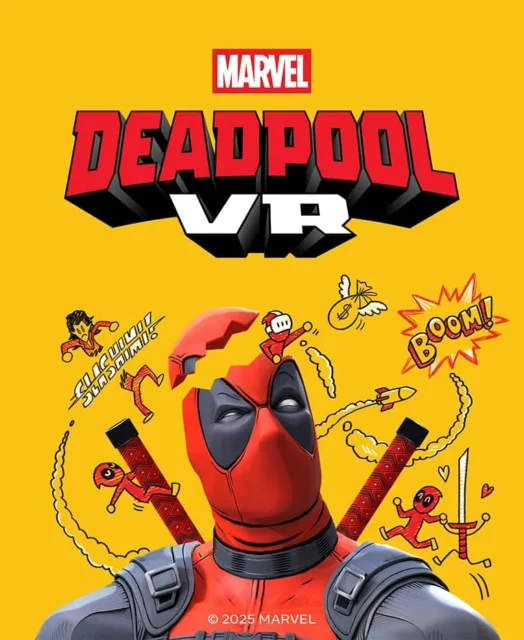
Marvel‘s most irreverent antihero has arrived in virtual reality. Marvel’s Deadpool VR launched today, November 18, exclusively on Meta Quest 3 and Quest 3S, placing players directly in the middle of the character’s violent, absurd and frequently self-aware adventures.
The game is developed by Twisted Pixel Games in collaboration with Marvel Games, with Neil Patrick Harris voicing Deadpool. Its US price is $49.99.
For the VR industry, it is a prominent franchise release built specifically around headset interaction. Rather than simply showing a superhero on a virtual theater screen, the game asks players to fight, move and improvise from inside Deadpool’s perspective.
An original trip through Mojoworld
The game’s story begins with Deadpool becoming entangled in an arrangement with Mojo, the entertainment-obsessed figure who rules Mojoworld. Voiced by John Leguizamo, Mojo offers Deadpool the prospect of becoming a star, with the predictable complication that the contract involves dangerous work.
Players move through locations connected to the wider Marvel universe, including a S.H.I.E.L.D. Helicarrier and Xandar, as Deadpool hunts other characters under Mojo’s watch.
That framework suits the protagonist. Deadpool has long been defined by jokes about the medium containing him, and a story about performing for an audience creates opportunities to address the player directly.
The game is not positioned as a straightforward adaptation of one particular film or comic-book story. Its creative team has developed a separate VR adventure using familiar Marvel characters and settings.
Combat that encourages experimentation
The release emphasizes a fast-paced blend of melee combat, gunplay and physical movement. Deadpool can use swords and firearms, improvise with the environment and perform deliberately ridiculous attacks.
Meta and Marvel are also highlighting a combat gimmick appropriate to a character who regenerates: players can use a severed body part as a weapon. It is an intentionally grotesque example of designing interactions for the specific fantasy of inhabiting Deadpool.
The wider system encourages creative approaches rather than a single optimal button combination. A player might move through an encounter using a mixture of weapons and environmental actions, with the game rewarding particularly theatrical results.
These ideas are a natural match for virtual reality. Motion controls can make improvisation feel personal, while a first-person perspective gives exaggerated combat a different rhythm from traditional superhero games.
However, complex physical combat brings challenges. Hit detection, animation responses and movement comfort all need careful balancing. Launch-day marketing demonstrates the intended experience, not how every user will respond to it.
A different voice for the character
Neil Patrick Harris takes the lead role rather than Ryan Reynolds, who is strongly associated with Deadpool’s film appearances. That creates an opportunity to give the game its own identity without reproducing the exact tone and delivery of the movies.
Voice acting is particularly important here because the player’s eyes and hands occupy the character’s point of view. The protagonist’s personality is communicated largely through dialogue, timing and reactions to the player’s actions.
Too little commentary could make Deadpool feel like a generic action hero. Too much could become exhausting during extended VR sessions. The game has to find a balance between constant jokes and the player’s need to concentrate on physical movement.
John Leguizamo’s casting as Mojo adds another distinctive performance and supports the production’s theatrical premise.
Why Quest 3 exclusivity matters
Marvel’s Deadpool VR is available on Quest 3 and Quest 3S, rather than the earlier Quest 2 or other competing headset platforms. That narrower device target allows the developers to focus on the processing capabilities and features of Meta’s newer standalone hardware.
It also restricts the audience to owners of compatible Quest devices. Fans playing on PlayStation VR2 or SteamVR do not have an announced version they can purchase today.
For Meta, the exclusivity is a way to make its hardware ecosystem more attractive. Well-known entertainment properties can bring attention beyond the traditional group of VR enthusiasts, especially when the game offers interactions that would be difficult to reproduce outside a headset.
The trade-off for a VR studio is obvious: a narrower launch platform can reduce potential sales even as it simplifies development and strengthens a distribution partnership.
A premium release with a recognizable name
At $49.99, Deadpool VR sits in the premium portion of the Quest game market. Customers are being asked to pay for a substantial branded action adventure, not a short experimental demo.
That places pressure on content depth, encounter variety and overall polish. A successful VR game has to remain comfortable and engaging well past the opening sequence, regardless of how recognizable its protagonist may be.
For Marvel, the game is also a test of how well comic-book personality translates into player agency. Deadpool’s humor depends heavily on timing and surprise; VR adds the unpredictable behavior of a person physically occupying the scene.
Another milestone for VR-exclusive games
The launch gives Quest users a major entertainment property built around the strengths and peculiarities of VR. Its combination of first-person combat, Marvel locations and deliberately excessive humor makes it one of the season’s more distinctive releases.
Whether it becomes a defining headset game will depend on how much fun players have over a complete campaign, and how well its physical interactions hold together outside promotional footage.
For now, the news is clear: Marvel’s Deadpool VR is out on Quest 3 and 3S for $49.99, bringing a major comic-book character into an original immersive adventure rather than another conversion of an existing flat-screen game.
Related coverage on Virtual Reality Times
- Marvel’s Deadpool VR Announced as a Quest 3 Exclusive Starring Neil Patrick Harris
- Meta Quest 3S Xbox Edition Launches at $399.99 With Controller and Game Pass
- Lenovo and Disney Launch a Marvel ‘Dimension of Heroes’ For Mirage AR Headset
- Marvel’s Iron Man VR Releases in 2019
- Marvel Powers United VR Announced for Oculus Rift
Sources
https://virtualrealitytimes.com/2025/11/18/marvels-deadpool-vr-launches-on-quest-3-with-neil-patrick-harris-and-chaotic-combat/https://virtualrealitytimes.com/wp-content/uploads/2025/11/marvel-deadpool-vr-2025-11-18-524x640.webphttps://virtualrealitytimes.com/wp-content/uploads/2025/11/marvel-deadpool-vr-2025-11-18-150x90.webpGamingMetaOculus QuestDeadpool Quest 3,Marvel Deadpool VR,Neil Patrick Harris Deadpool,Twisted Pixel,VR superhero gamesMarvel's most irreverent antihero has arrived in virtual reality. Marvel's Deadpool VR launched today, November 18, exclusively on Meta Quest 3 and Quest 3S, placing players directly in the middle of the character's violent, absurd and frequently self-aware adventures. The game is developed by Twisted Pixel Games in collaboration with...Virtual Reality Times [email protected]SubscriberVirtual Reality Times
Leave a Reply